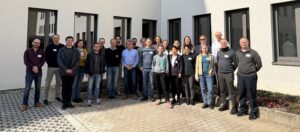
More than 30 researchers and project partners gathered in Erlangen for the DyHealthNet workshop on March 19-20. Within these two days, several interesting presentations and discussions from professionals in the field of population cohorts took place, including researchers from the SHIP and FinnGen study, and the Pan-Canadian Genome Library. We also presented our experiences from nearly two years within the DyHealthNet project, and collected valuable feedback for the progress of our project. Overall, the workshop fostered in-depth discussions on research challenges, collaboration strategies, and future directions for the work with population cohorts. We would like to thank all contributors making their way to Erlangen.
Date: 19.03.2026 – 20.03.2026
Location: Department Artificial Intelligence in Biomedical Engineering, Nürnberger Straße 74, 91052 Erlangen, Germany
Content:
Epidemiological population cohorts offer a comprehensive overview of the health state of the general population and can thus, in contrast to studies with a disease focus, better capture the normal physiological range of measurements while offering insights into a broad set of pathological conditions. In this workshop, we want to bring together experts in genomics, network medicine, and data science to shape the future of such large-scale population cohort research. We expect to enable participants to exchange insights on innovative computational approaches and collaborative frameworks to unlock the full potential of population cohort data while also ensuring ethical and secure research practices.
Program:
| Day 0 (18.3.2026) | |
| 19:30 | Preparatory dinner for the workshop organizers (Internal) |
| Day 1 (19.3.2026) | |
| 13:00 – 13:45 | Registration |
| 13:45 – 14:00 | Welcome by the organizers |
| Talks Session 1 (18min. talk + 7min. Q&A) | |
| 14:00 – 14:25 | From genome-wide screening for thyroid function loci towards improved diagnosis of thyroid disease
Speaker: Alexander Teumer, Greifswald |
| 14:25 – 14:50 | Exploring the Clinical Potential of Polygenic Risk Scores
Speaker: Lukas Forer, Innsbruck |
| 14:50 – 15:15 | Computational pathology and bioinformatics advancing precision oncology
Speaker: Fulvia Ferrazzi, Erlangen |
| 15:15 – 15:40 | Understanding the developmental origins of metabolic disorders by dissecting the multi-omic landscape of childhood adipose tissue
Speaker: Mauro Tutino, Munich |
| 15:40 – 16:15 | Coffee break |
| Talks Session 2 (18min. talk + 7min. Q&A) | |
| 16:15 – 16:40 | Integrating Network Medicine with Population Cohort Studies in the DyHealthNet Project
Speaker: Lis Arend, Munich & Fabian Woller, Erlangen |
| 16:40 – 17:05 | Genetic and Etiological Insights from Vascular Imaging in large cohorts: From Retinal to Cross-Organ and Classical to Deep Learning Analyses
Speaker: Sven Bergmann, Lausanne |
| 17:05 – 17:30 | Understanding structural variants using long-read genomics
Speaker: Tobias Rausch, EMBL |
| 17:30 – 17:55 | Where does it hurt (in your genome)?
Speaker: Julien Gagneur, Munich |
| 19:30 | Dinner at Kitzmann BräuSchänke (Südliche Stadtmauerstraße 25, 91054 Erlangen) |
| Day 2 (20.3.2026) | |
| Talks Session 3 (18min. talk + 7min. Q&A) | |
| 09:00 – 09:25 | Exploring and visualizing stratified genome-wide association study results with PheWeb2
Speaker: Daniel Taliun, Montreal |
| 09:25 – 09:50 | Development and prospective validation of AI models for the prediction of future abnormal clinical laboratory tests using genetics and multimodal EHR data in FinnGen
Speaker: Kira Detrois, Helsinki |
| 09:50 – 10:15 | Molecular Epidemiology Approaches with the Study of Health in Pomerania (SHIP) and the TIMES Cohort as Examples – Options for large scaleCollaboration Projects in Proteomics
Speaker: Uwe Völker, Greifswald |
| 10:15 – 11:15 | Coffee break & poster session |
| Talks Session 4 (18min. talk + 7min. Q&A) | |
| 11:15 – 11:40 | AMIGO – A federated European pediatric multi-omics infrastructure for precision medicine
Speaker: Daniel Weiss, Munich |
| 11:40 – 12:05 | Pan-Canadian Genome Library: a national initiative for genomic data sharing and impact
Speaker: Guillaume Bourque, Montreal |
| 12:05 – 13:00 | Closing remarks and discussion
Dr. Christian Fuchsberger, Prof. Dr. Markus List, Prof. Dr. David Blumenthal, Prof. Dr. Johann Gamper |
| 13:00 – 14:00 | Farewell and open discussions |
Contact: For more information, please contact Alessia Caria (alessia.caria@fau.de) or David Blumenthal (david.b.blumenthal@fau.de).